
Introduction and Overview
Community-engaged research anchors rigorous academic inquiry in collaborative partnerships between scholars and community organizations and members.
By centering equity and shared power in knowledge creation, this approach positions higher education as a genuine partner in addressing community priorities and advancing the public good.
In this section:
Community engagement continuum
Community engagement exists on a continuum. Some projects involve community input at specific stages, while others are fully co-created between community partners and researchers, with shared leadership from start to finish. All points on this continuum can produce valuable outcomes when grounded in community engagement values.
Community-facing research
- Research for the community
- Research relevant to community concerns is shared with community audiences
Community-connected research
- Research in the community
- Community consulted for information, perspectives, and feedback
Community-engaged research
- Research with the community
- Community involved in collaborative, equitable partnerships
Collaboration across the research process
Community engaged researchers work with communities as partners throughout the research process.
- Defining the research: Community partners help identify what questions matter most and shape the research design to ensure it addresses real needs
- Collecting data: Partners may participate in gathering information, helping ensure culturally appropriate methods and access to community knowledge
- Analyzing and interpreting findings: Community expertise is essential for understanding what the data means in context and what findings are most significant
- Sharing results and taking action: Findings are shared with the community in accessible ways, and partners collaborate on how research translates into community benefit
Why CER Matters
Community-engaged research benefits everyone involved and produces more robust, consequential scholarship.
Research becomes a tool for addressing priorities you've identified, not just academic interests. Through partnership, community members and organizations:
- Build research skills and capacity
- Gain access to resources and expertise
- Maintain agency over how knowledge about your community is created and used
- Produce findings that are designed to be actionable for your context
Strong community partnerships also build trust that both supports future research and opens doors that, otherwise, may remain closed.
Working with community partners leads to research questions that are more relevant and findings that are more likely to be implemented in the real world. Partners provide essential contextual knowledge that helps you:
- Design culturally appropriate methods
- Interpret data accurately
- Understand what your findings actually mean on the ground
Strong community partnerships build trust that supports future research and opens doors that might otherwise remain closed.
Community engagement enhances research quality and relevance. When community members help shape research questions, you are more likely to ask the right questions in the first place.
When partners participate in data collection and analysis, you gain perspectives that prevent misinterpretation and ensure findings reflect lived reality. The result is scholarship that is both academically sound and genuinely useful.
Community Engagement Values
There are several key principles that set Community Engagement apart from other forms of public scholarship and experiential learning.
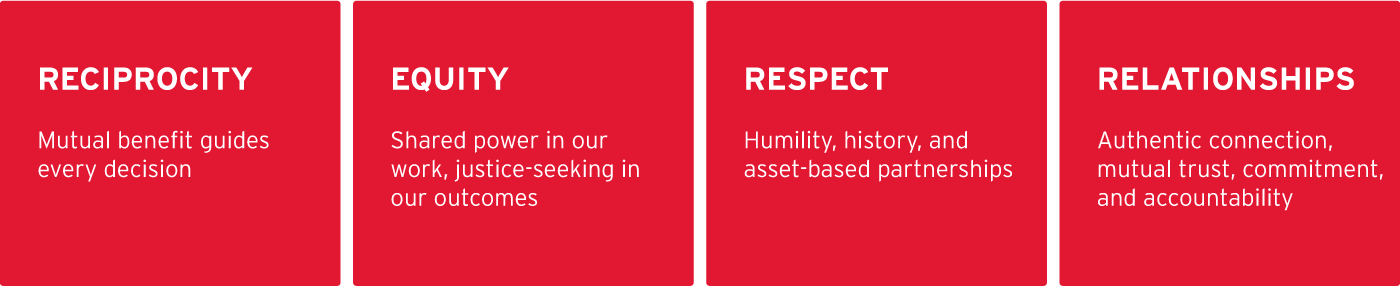
Mutual benefit guides every decision
- All partners contribute to and benefit from the collaboration
- All partners bring valuable knowledge, expertise, and assets essential to addressing complex challenges
Shared power in our work, justice-seeking in our outcomes
- Equity is reflected in both the outcomes of the work and the processes by which partners work together
- Partnerships are characterized by shared power, decision-making, resources, and responsibility
- Partners acknowledge that community needs arise from historical and ongoing injustice
- Project aims work to address root causes of inequity, centering voices, perspectives, and knowledge that have been historically marginalized
Humility, history, and asset-based partnership
Campus partners:
- Respect community knowledge, expertise, cultural intelligence and lived experiences
- Approach projects with an asset-based mindset, recognizing what communities have, not only what they lack
- Work from an understanding of the community’s historical context, including the history of universities extracting knowledge from communities without giving back
Authentic connection, mutual trust, commitment, and accountability
- Partners invest in ongoing trust-building through transparency, honesty, accountability, and genuine connection
- Partners can expect the relationship to be:
- Long-term, extending beyond a single project
- Multifaceted, meaningfully including each other in multiple ways
- Adaptive, as contexts change and all parties learn
- Partners engage in ongoing reflection and growth, continually examining assumptions, behaviors, and how the work fits within each other's larger systems
- Relationships deepen over time through shared experiences, once transactional relationships become transformational for all parties